Weber-Fechner Law

The smallest noticeable change scales with the original.

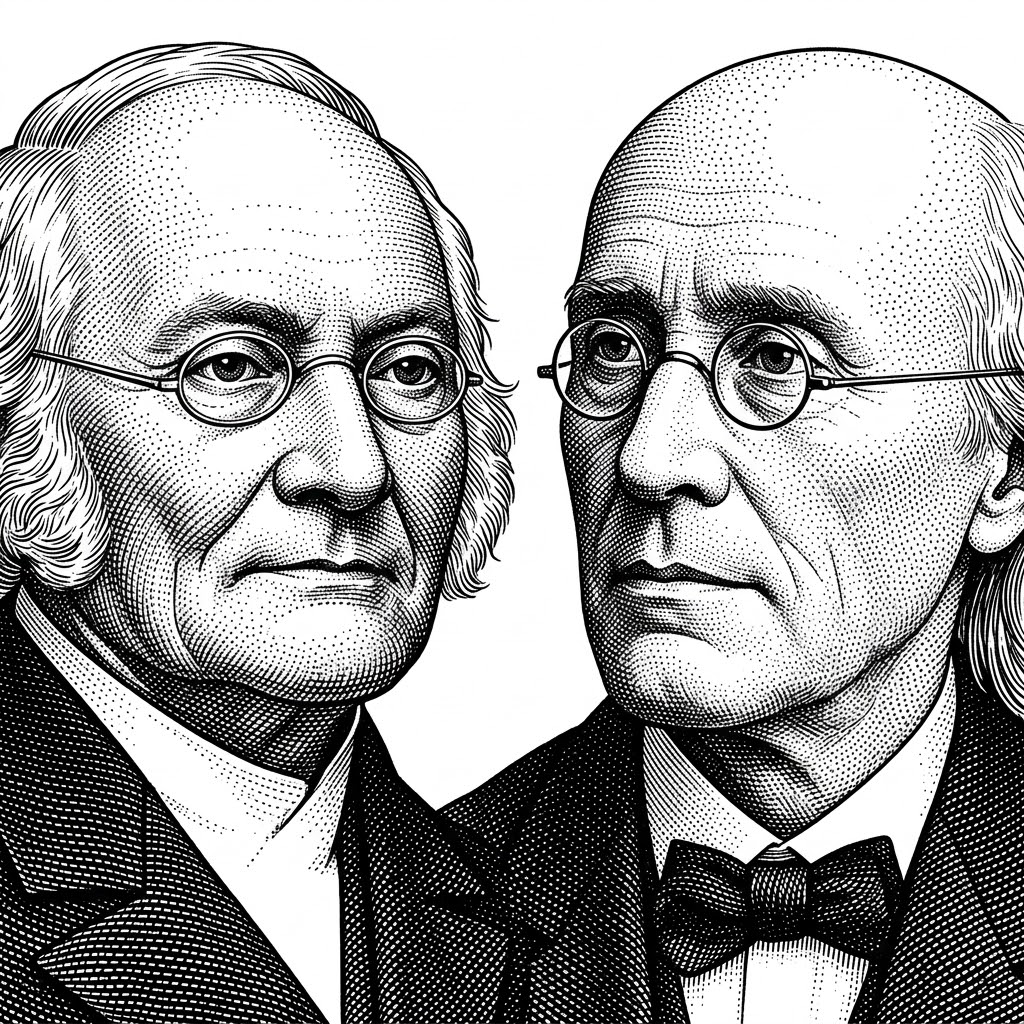
Ernst Weber (1834) and Gustav Fechner (1860) formalized the relationship between physical stimulus and perceived intensity. The smallest detectable change isn’t a fixed amount — it’s a fixed proportion of what’s already there. The law shows up in volume, brightness, price, weight, animation timing, and design contrast.

ΔI / I = k (Weber) and S = k · log(I) (Fechner)
the noticeable change is a constant fraction of the stimulus, so sensation grows logarithmically.
Origin

Ernst Heinrich Weber, a German physician, measured in the 1830s how much a stimulus must change before people notice. Gustav Fechner, his student, formalized the relationship as a logarithmic law in 1860 — founding the field of psychophysics.

Weber established the just-noticeable difference through meticulous weight-lifting experiments at Leipzig. Fechner — physicist, philosopher, and occasional satirist under the pen name Dr. Mises — had the insight on the morning of 22 October 1850, a date psychophysicists still celebrate as Fechner Day.

The Law

The just-noticeable difference (JND) in a stimulus is a constant fraction of the stimulus itself. Going from a $10 latte to $11 is noticeable; going from a $1,000 laptop to $1,001 isn’t. The eye, the ear, and the wallet all run on ratios, not absolutes.

Coined by
Ernst Weber (1834) and Gustav Fechner (1860)
Source
Psychophysics
In practice
Make changes proportionally noticeable
JND

The Just-Noticeable Difference

Pick up a 200g weight; add 10g and you’ll feel it. Pick up a 2,000g weight; add 10g and you won’t. The threshold for detecting change isn’t 10g — it’s about 5% of whatever you started with. Every sensory channel has its own Weber fraction, and they’re surprisingly stable.

Rule
JND scales with stimulus
Channels
Weight · sound · light · price
Pricing

Pricing Runs on Ratios

Marketers internalized this a long time ago. Discounts get framed as percentages, not amounts; an upsell is “just $5 more” on a small purchase and “barely 5%” on a big one. The user’s perceived price-change is a Weber fraction of the anchor.

Framing
Percentage beats absolute
Apply to
Discount · upsell · tier
Typography

Type Scales Are Weber Curves

Modular type scales — 1.125, 1.25, 1.333, 1.5, the golden ratio — exist because absolute jumps look uneven. A scale where each step is the same percentage larger than the last reads as a proportional hierarchy: each level is noticeably bigger than the one below it.

Common ratios
1.25 · 1.333 · 1.5
Effect
Hierarchy reads as steps
Contrast

Contrast Is Multiplicative

WCAG contrast ratios are Weber-Fechner under the hood — perceived contrast scales with the ratio of luminances, not the difference. That’s why dark mode and light mode need different absolute colors to feel equally readable, but the same minimum ratio (4.5:1 for body text).

WCAG
Ratio-based
Test
Body ≥ 4.5:1
Animation

Animation Timing Is Logarithmic

Animation duration follows perception, not stopwatch. Doubling a 100ms transition to 200ms feels twice as long; doubling a 1000ms transition to 2000ms feels much less than twice. Material’s motion guidelines bake this in — durations curve with element size and distance, not with raw pixels.

Implication
Long ≠ proportionally long
In Material
Distance-scaled timing
A/B

A/B Tests Need Proportional Deltas

A 5% improvement at a baseline of 10% conversion is huge; the same 5% at a baseline of 80% is barely detectable. Most A/B test power calculations are Weber in disguise — you need to translate the absolute delta into a proportional one before judging whether it’s worth chasing.

Compare
Proportional, not absolute
Power-calc
Weber in disguise
Notifications

Notification Fatigue Is Weber Too

The fifteenth notification of the morning gets less attention than the first — not because anything changed about that single notification, but because it’s now 7% of fifteen instead of 100% of one. Each new alert is judged against the baseline noise it’s added to.

Pattern
Each Δ shrinks vs baseline
Tactic
Send fewer · clearer
Limits

The Law Holds at Mid-Range

Weber-Fechner is most reliable in the middle of a sensory range. At very faint stimuli (whispers, faint colors) and very intense ones (loud noises, blinding light) the ratio drifts. For UX purposes you’re almost always in the mid-range, where the law works cleanly.

Holds at
Mid-range stimuli
Drifts at
Very faint · very intense

Weber-Fechner in the Age of AI

AI is the new stimulus stream — and it arrives at a volume that quickly resets every baseline.

✦ AI Era

AI Resets the Baseline

A year ago, an auto-summary was novel. Today it is invisible because every product has one. The user’s baseline keeps shifting up, and the same feature has to keep getting better to feel like the same delta. Weber-Fechner in motion: shipping the third-best summary in 2026 will feel worse than shipping the best summary did in 2024.

Effect
Wow shrinks fast
Implication
Ship fast · raise bar
✦ AI Era

Generated Variation Hits Weber

A model that varies an image slightly across users, or tweaks a notification by a few percent, may be operating below the JND. Lots of tuning that looks busy in code is invisible to users. Worth checking whether the variation is meaningful — or just noise the user can’t detect.

Question
Is the variation noticeable?
Tactic
Measure the JND first
Further Reading